By Dr. Nimish [B.V.Sc] | Veterinarian & Founder of Feedelpoint
In the United States, there is a common scene that plays out in homes with senior dogs. It’s 2:00 AM. The house is dark. But instead of sleeping, you hear the unmistakable click-click-click of nails on hardwood floors. Your old dog is pacing. Maybe they are staring at a wall. Maybe they are panting. Maybe they just can’t seem to get comfortable. Sleep changes are often the very first sign of aging that owners notice. But unlike a limp, sleep issues are confusing. Is he in pain? Is he confused? Does he just need to pee?
As a veterinarian, I look at sleep as a vital sign. Quality sleep is when the body repairs tissue, clears metabolic waste from the brain, and resets the immune system. If your senior dog isn’t sleeping well, they are aging faster.
“Sleep is a critical component of their overall wellbeing, but it works in tandem with diet and general health, which we cover extensively in our Senior Dog Care Guide 101: Health, Mobility & Nutrition for Aging Dogs.“
This Senior Dogs Sleep and Comfort Guide is your comprehensive manual to understanding senior dogs sleep — why it changes, when to worry, and how to build a “Sleep Sanctuary” that gives them (and you) a good night’s rest.
Part 1: The “New Normal” – How Much Sleep is Too Much? First Step In Senior Dogs Sleep and Comfort Guide
First, let’s establish a baseline. Puppies sleep a lot because they are growing. Seniors sleep a lot because they are tired.
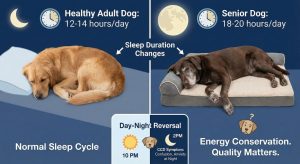
A healthy adult dog sleeps about 12-14 hours a day. A senior dog? It is normal for them to sleep 18 to 20 hours a day.
If your 12-year-old Labrador spends most of the day snoozing on the rug, that is not necessarily depression. It’s energy conservation. Their metabolic engine is running slower. However, the quality of that sleep matters more than the quantity.
The Red Flag: “Day-Night Reversal”
The warning sign isn’t that they are sleeping; it is when they are sleeping.
If your dog sleeps like a rock from 9 AM to 5 PM but is wide awake, pacing, and anxious from 10 PM to 4 AM, this is Day-Night Reversal. It is a classic symptom of Canine Cognitive Dysfunction (CCD)—dog dementia. Their internal circadian clock has broken, and they no longer know when “sleep time” is.
Part 2: Why They Struggle at Night (The “Big Three”)
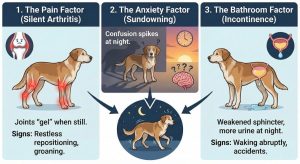
When a client tells me their senior dog is restless at night, it is almost always one of three things. You need to play detective to figure out which one it is.
1. The Pain Factor (Silent Arthritis)
Joint pain is worse at night. During the day, moving around keeps the joints lubricated. At night, when they lie still for 3 hours, the inflammation settles in and the joints “gel” (stiffness).
- The Sign: Your dog lies down, sighs, gets up 10 minutes later, spins three times, lies down again, and groans. They are trying to find a position that doesn’t hurt their hips or shoulders.
“Since pain is often the root cause of sleeplessness, knowing the Early Signs of Arthritis in Senior Dogs You Should Never Ignore can help you address the discomfort before it ruins their rest.”
2. The Anxiety Factor (Sundowning)
Just like human Alzheimer’s patients, dogs experience “Sundowning.” As the light fades, their confusion spikes. Shadows look scary. They forget where their bed is. They feel vulnerable in the dark because their vision is failing.
- The Sign: Pacing aimlessly, panting without exertion, or getting “stuck” in corners or behind furniture.
3. The Bathroom Factor (Incontinence)
As dogs age, the sphincter muscle that holds urine weakens. At the same time, kidneys often lose their ability to concentrate urine, meaning they produce more pee at night.
- The Sign: Waking up abruptly and rushing to the door, or finding wet spots where they were sleeping.
The “7-Day Sleep Snapshot” (Do This Before Visiting Your Personal Veterinarian) When clients come to my clinic saying “he doesn’t sleep,” my first question is always: “What exactly happens?” Before you book an appointment, keep a simple log for 7 days. Track these four things:
-
Bedtime & Wake Time: Is it consistent?
-
The “2 AM Activity”: Is he pacing? Panting? Staring at a wall?
-
Water Intake: Is he drinking heavily before bed?
-
Stiffness: Does he struggle to stand up immediately after waking?
Bring this log to your vet. It helps us distinguish between pain (stiffness) and cognitive dysfunction (pacing).
Part 3: The Sleep Sanctuary – Building the Ideal Bed
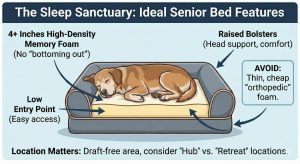
If you are sleeping on a lumpy mattress with a bad back, you will wake up in pain. The same applies to your dog. Those thin, cute fluffy beds from the discount aisle are actively hurting your arthritic senior.
When I help owners design a senior-friendly space, I don’t just look at the bed. I look for a “Comfort Triangle”—three elements that must work together:
-
Support: The bed itself (saving the joints).
-
Stability: The floor traction (preventing slips).
-
Security: The lighting and routine (reducing anxiety).
If you have a great bed but a slippery floor, the triangle is broken, and your dog will still be anxious.
The “Orthopedic” Lie
Be careful with the word “Orthopedic” in US pet stores. It is not a regulated term. Anyone can slap it on a piece of cheap egg-crate foam.
What to look for:
- Memory Foam: You want solid, high-density memory foam (at least 4 inches thick). You should be able to press your hand into it and not feel the floor. If you can feel the floor, it’s useless for a 70lb dog.
- Bolsters: Senior dogs love “bolster beds” (beds with raised sides). They use the bolster as a pillow to prop up their head, which helps if they have mild heart or breathing issues.
- Low Entry: Avoid beds with high walls they have to step over. A “sofa style” bed with one open side is best.
The Location Matters
- Draft-Free: Seniors cannot regulate their body temperature well. Keep the bed away from drafty windows or AC vents.
- The “Hub” vs. The “Retreat”: Have two beds. One in the family room (so they don’t get FOMO – Fear Of Missing Out) and one in a quiet bedroom for deep sleep.
Vet’s Tip: The “Two-Zone” Trick Just like you might prefer a firm chair sometimes and a soft sofa other times, senior dogs have “good joint days” and “bad joint days.” I recommend a Two-Zone Setup: Keep a firmer orthopedic mattress in the bedroom for deep support, but offer a slightly softer “nesting” bed in the living room. Let your dog choose which surface feels best for their inflammation level that day.
Part 4: Temperature Control (The Forgotten Variable)
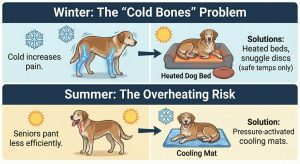
In the USA, we blast AC in the summer and heating in the winter. Seniors are sensitive to both.
Winter: The “Cold Bones” Problem
Cold weather makes joint fluid thicker and increases pain.
- Solution: Heated Dog Beds. You can buy beds with built-in low-voltage heaters, or microwaveable “snuggle discs” that stay warm for 8 hours.
- Safety Note: Never use a human heating pad; it can burn their skin. Use pet-specific products that only heat up to a safe 102°F.
Summer: The Overheating Risk
Seniors pant less efficiently. If they are heavy-coated (like a Husky or Golden), they can overheat in sleep.
- Solution: Cooling Mats. These are pressure-activated gel mats that cool down when the dog lies on them. Place one next to their bed so they can choose to roll onto it if they get hot.
Part 5: Managing the Night (Practical Solutions)
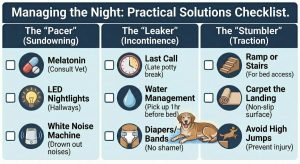
Here is a checklist for solving the specific night-time struggles.
1. For the “Pacer” (Sundowning)
- Melatonin: Talk to your vet about Melatonin. It is safe and helps reset the circadian rhythm.
- Nightlights: Plug in LED nightlights in the hallway and near their water bowl. Seniors with cataracts see poorly in dim light; total darkness is terrifying for them.
- White Noise: A fan or a white noise machine can help drown out the scary “night noises” (trash trucks, wind) that trigger anxiety.
2. For the “Leaker” (Incontinence)
- The “Last Call”: Move their final potty break to as late as possible (right before you go to sleep).
- Water Management: Do not restrict water (this damages kidneys), but pick up the water bowl 1 hour before bed.
- Diapers/Belly Bands: There is no shame in using doggie diapers or “belly bands” (for males) at night. It saves your floors and, more importantly, stops you from getting angry at them for accidents they can’t control.
3. For the “Stumbler” (Traction)
If your dog sleeps on your bed, you must install a ramp or stairs.
- The Danger Zone: The jump off the bed in the dark is the #1 cause of acute soft tissue injuries in my senior patients.
- Carpet the Landing: Put a non-slip yoga mat or rug right where they step out of their bed. Slipping immediately upon waking up sets a tone of fear for the day.
“Preventing these slips is vital for their confidence; for a more detailed look at managing their movement throughout the house, check out our full Senior Dog Mobility & Joint Care Guide: From First Limp to Daily Comfort.“
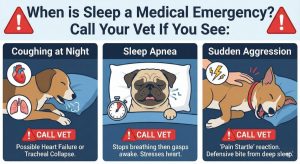
Part 6: When is Sleep a Medical Emergency?
Sometimes, sleep issues are a sign of organ failure. Call your vet if you see:
- Coughing at Night: If your dog sleeps fine but wakes up coughing, this is a classic sign of Heart Failure (fluid accumulating in the lungs when they lie flat) or Tracheal Collapse.
- Sleep Apnea: Does your dog stop breathing for 10-20 seconds and then gasp awake? This happens in flat-faced breeds (Pugs, Bulldogs) and stresses the heart.
- Sudden Aggression: If you touch your sleeping dog and they bite, it’s likely a “pain startle.” They were in a deep sleep, you touched a sore hip, and they reacted defensively.
Conclusion: Empathy is the Best Medicine
The hardest part of senior dog care is the lack of sleep—for you. I know how frustrating it is to be woken up at 3 AM every night for months.
But remember: Your dog isn’t doing this to annoy you. They are confused, uncomfortable, or trying to follow a biology they can no longer control.
By upgrading their bed, adding a nightlight, and managing their pain with your vet, you can often turn a restless pacer back into a peaceful sleeper. Build them a sanctuary where they feel safe, warm, and grounded. They have spent their whole life guarding your sleep; now it is time for you to guard theirs.
FAQ
How can I help my senior dog sleep through the night?
Start with comfort and routine: supportive bed, traction on floors, calm bedtime routine, and a final potty break. If restlessness is new or intense, talk to your vet to rule out pain or medical causes.
Is it normal for senior dogs to sleep a lot?
Yes. Many senior dogs sleep 12–15 hours daily, and some may sleep more. What matters most is a sudden change in sleep habits or sleep changes paired with other symptoms.
Why is my senior dog pacing at night?
Common causes include discomfort/pain, anxiety, needing to urinate, vision changes, and cognitive dysfunction. Cognitive dysfunction in dogs can involve sleep–wake cycle disturbances and nighttime wandering.
Should I leave a light on for my old dog at night?
Often, yes—soft lighting can help seniors who are anxious, visually impaired, or cognitively confused at night. Keep it dim and consistent so it’s calming, not stimulating.
What are signs my dog’s sleep issue is pain?
Hesitating to lie down, frequent repositioning, licking joints, stiffness after rest, or being more restless after activity can point to discomfort. A vet exam is the safest way to confirm and treat pain.
When should I worry about a senior dog not sleeping?
Worry less about “one bad night” and more about sudden or escalating changes, accidents, breathing issues, severe panting at rest, collapse, or confusion. Call your vet if you’re unsure.
Veterinary Disclaimer
I am a veterinarian, but I am not your dog’s veterinarian. The information provided in this article—specifically regarding Melatonin and pain management—is for educational purposes only. Always consult with your local veterinarian in the US before starting new supplements or medications.
I created this platform with a single mission: to bridge the gap between complex medical information for senior dog owners and practical loving home care.
My Background: I hold a Bachelor of Veterinary Science (BVSc). My education gave me the medical foundation to understand the physiology of aging dogs, from joint mobility to nutritional needs.