By Dr. Nimish [B.V.Sc] | Veterinarian & Founder of Feedelpoint
There is a specific moment that every dog owner eventually faces. It might be the day you notice your Golden Retriever hesitating before jumping into the SUV, or the morning your Beagle has a little “frost” on his muzzle that wasn’t there last month. It’s the realization that your puppy is growing up and you have to get a complete Senior Dog Care Guide.
In the United States, we love our dogs like children. We share our beds, our road trips, and our lives with them. But caring for a senior dog requires a shift in mindset. It isn’t just about “maintenance” anymore; it is about proactive management.
As a veterinarian, one of the most common phrases I hear in the exam room is, “Oh, he’s just slowing down because he’s old.”
Here is the truth: Old age is not a disease. “Slowing down” is often a code word for manageable pain, untreated illness, or confusion.
This guide is your roadmap. It is designed to take the fear out of the aging process and replace it with action. Whether you have a 7-year-old Great Dane or a 12-year-old Chihuahua, this is how you ensure their golden years are truly golden.
Part 1: When Does a Dog Actually Become “Senior”? First Part of Senior Dog Care Guide
In the US, we often hear the “one dog year equals seven human years” rule, but that is a massive oversimplification. Aging is not a one-size-fits-all process; it is dictated by biology and size.
If you walk into a veterinary clinic, we generally categorize dogs as “senior” when they reach the last 25% of their expected lifespan. However, the American Animal Hospital Association (AAHA) guidelines suggest we start senior health monitoring much earlier than owners expect.
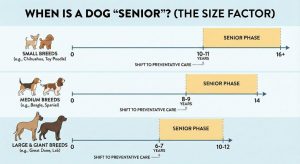
The Size Factor
- Small Breeds (Chihuahuas, Toy Poodles): These dogs are practically eternal. They often don’t hit “senior” status until 10–11 years old. I have seen healthy 16-year-old Yorkies who still run the house.
- Medium Breeds (Spaniels, Beagles): They typically enter the senior phase around 8–9 years old.
- Large & Giant Breeds (Labs, Shepherds, Danes): This is the heartbreaking reality of big dogs. A Great Dane may be considered senior as early as 6 or 7 years old.
Understanding this timeline is critical because it tells you when to switch from “reactive” care (going to the vet only when they are sick) to “preventative” senior care (screening for things you can’t see yet).
Part 2: The “Silent” Signs of Aging (What Vets See That You Miss)
Dogs are evolutionary masterpieces of deception. In the wild, showing pain made you a target, so our domestic dogs have retained a stoic ability to hide discomfort until they literally cannot mask it anymore.
When owners tell me their dog is “fine, just old,” I often look for the micro-signals. These are the subtle behavioral shifts that act as early warning lights on your dog’s dashboard.
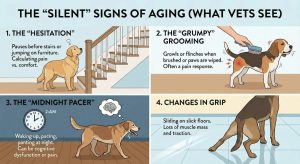
1. The “Hesitation”
Watch your dog when they interact with their environment. Do they stop at the bottom of the stairs for two seconds before going up? Do they put their front paws on the couch and look at you instead of hopping up?
This isn’t laziness. This is a physics calculation. Your dog is calculating if the pain of the jump is worth the comfort of the couch.
2. The “Grumpy” Grooming
If your normally sweet dog suddenly growls when you brush their lower back or hips, or if they flinch when you wipe their paws after a rainy walk, this is rarely a behavioral issue. It is almost always a pain response. Lower back pain and hip arthritis can make the skin incredibly sensitive to touch.
3. The “Midnight Pacer”
Is your dog waking up at 2 AM, clicking their nails on the hardwood floor, panting, or wandering aimlessly? We often mistake this for a need to use the bathroom. While that can be true, it is frequently a sign of Canine Cognitive Dysfunction (CCD)—essentially dog dementia—or anxiety caused by the inability to get comfortable due to joint pain.
“If night-time restlessness is a struggle in your home, I have created a dedicated protocol to help; you can find the full solutions in my Senior Dogs Sleep and Comfort Guide: Creating a Pain-Free Resting Space.“
4. Changes in Grip
Have you noticed your dog sliding more on your tile or laminate floors? As dogs age, they lose muscle mass and their paw pads can become drier and slicker. If you see their back legs “splitting” out like Bambi on ice, they are struggling for traction.
Part 3: Mobility and Joint Care (The Foundation)
Mobility is usually the first pillar of health to crumble. The United States has a high prevalence of canine osteoarthritis, partly due to genetics and partly due to the obesity epidemic in our pets.
You cannot reverse arthritis, but you can manage it so effectively that your dog forgets they have it.
The “Use It or Lose It” Philosophy
The worst thing you can do for a stiff dog is stop exercising them. Joints are lubricated by movement. However, the type of exercise must change. We need to trade high-impact activities for low-impact consistency.
If you used to play 20 minutes of intense frisbee, switch to three 15-minute “sniff walks.” Sniffing is mentally exhausting for dogs (which is good!) but physically low-impact. If you have access to a pool or a canine hydrotherapy center, which are increasingly available in states such as California, Florida, and New York, swimming is the recommended activity.
Home Modifications: The “Senior-Proofing” Checklist
You baby-proofed your home when you got a puppy. Now, you must senior-proof it.
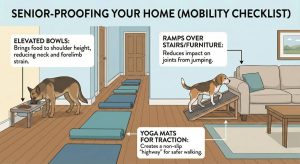
- Yoga Mats are Your Best Friend: You don’t need expensive rugs. Cheap yoga mats aimed down hallways create a “highway” of traction for your dog.
- Ramps Over Stairs: If your dog sleeps in your bed, the jump down is more damaging than the jump up. The impact on the front shoulders is immense. A ramp is a non-negotiable investment for senior dogs who sleep on high furniture.
- Elevated Bowls: There is some debate on this, but generally, if your dog has neck pain or arthritis in the forelimbs, bringing the food up to shoulder height prevents them from having to shift all their weight forward to eat.
“Changes in Movement: Is your dog slipping on tiles or hesitating at the stairs? These are solvable problems. Don’t let them struggle; read my dedicated guide on [Senior Dog Mobility & Joint Care Guide].
A Note on Pain Management
Please, never give your dog human pain medication (like Ibuprofen or Tylenol) without explicit veterinary instruction. These can be fatal. Modern veterinary medicine in the USA has incredible options now, from daily NSAIDs (Non-Steroidal Anti-Inflammatory Drugs) to monthly monoclonal antibody injections that target pain receptors without damaging the kidneys. If you think your dog is in pain, there is a safe solution available.
A Note from the Vet: What I Wish My Clients Knew
If I could sit every senior dog owner down for a coffee, there is one thing I would tell them: “Old age is not a diagnosis. It is often just a cover for untreated pain.”
The hardest part of my job isn’t the surgeries or the long hours. It’s seeing a dog who has been in silent pain for six months because their owner thought they were “just slowing down.”
We often think that if a dog is in pain, they will whine or cry. But in the wild, a loud animal is a vulnerable animal. Your dog’s instinct is to hide weakness. So, instead of crying, they just stop jumping on the sofa. Instead of limping, they just sleep more. They aren’t being “lazy”—they are protecting themselves.
I cannot tell you how many times I have convinced a reluctant owner to try a 14-day trial of pain medication for their 12-year-old Lab, only to have them call me a week later in tears saying, “He’s playing with toys he hasn’t touched in two years. I thought he was just old, but he was hurting.”
Please, don’t assume their slowed pace is inevitable. Let us check for pain. You might be surprised to find that your “old” dog has a lot of puppy left in them, once the aches are gone.
Part 4: Nutrition and the Weight Battle
The single most effective thing you can do to extend your senior dog’s life is to keep them lean.
In the US, over 50% of our dogs are overweight. For a senior dog, three extra pounds is like carrying a bowling ball in a backpack while having bad knees.
The Metabolism Shift
As dogs age, their metabolic rate drops. They burn fewer calories simply existing. If you continue feeding the same portion size you fed them at age four, they will gain weight. You almost invariably need to reduce portions or switch to a less calorie-dense food.
The “Low Protein” Myth
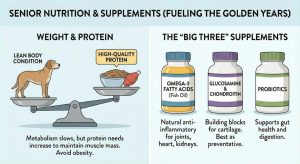
Decades ago, there was a belief that protein damaged senior kidneys, so “senior diets” were low in protein. Science has corrected this. Unless your dog has diagnosed kidney disease (confirmed by blood work), they actually need more high-quality protein, not less.
Why? Because seniors lose muscle mass rapidly (a condition called sarcopenia). They need protein to maintain the muscles that support their aging joints. Look for foods where real meat is the first ingredient and the protein percentage is adequate to support muscle maintenance.
Supplements: The Big Three
The pet supplement market in the US is a billion-dollar industry, and it is full of snake oil. However, there are three categories backed by solid science:
- Omega-3 Fatty Acids (Fish Oil): High doses of EPA and DHA act as a potent natural anti-inflammatory for joints, heart, and kidneys.
- Glucosamine/Chondroitin: While results vary, these are the building blocks of cartilage. They work best as a preventative measure.
- Probiotics: Senior digestion can get sensitive. A good probiotic can help maintain gut health and improve stool quality.
Part 5: Dental Health is Systemic Health
I cannot stress this enough: Rotten teeth can kill your dog.
It sounds dramatic, but it is physiological fact. The tartar and plaque on your dog’s teeth are essentially hardened bacteria. Every time your dog chews, that bacteria enters the bloodstream through inflamed gums. It then travels to the heart valves, the kidneys, and the liver.
In older dogs, heart murmurs and kidney failure are often exacerbated by years of poor dental hygiene.
The Anesthesia Fear
Many US owners are terrified of putting their senior dog under anesthesia for a dental cleaning. “He’s too old for surgery,” is a common fear.
While age does increase risk slightly, age is not a diagnosis. A healthy 14-year-old dog can handle anesthesia better than a sick 5-year-old. We do pre-anesthetic blood work specifically to mitigate these risks.
If a professional cleaning isn’t an option due to heart failure or other risks, you must be diligent at home. Enzymatic toothpastes, water additives, and dental wipes can help reduce the bacterial load, even if they aren’t as perfect as a scaling.
Part 6: Cognitive Health (Keeping the Lights On)
We talk a lot about the body, but the brain ages too. Canine Cognitive Dysfunction (CCD) is the dog equivalent of Alzheimer’s. It affects a huge percentage of dogs over 11, yet it is rarely diagnosed because owners think the symptoms are “just behavior.”
The Symptoms of CCD (DISHAA)
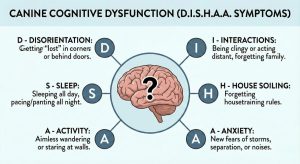
Vets often use the acronym DISHAA to track this:
- Disorientation: Getting “lost” in corners or behind doors.
- Interactions: Being clingy or, conversely, acting distant and forgetting family members.
- Sleep: Sleeping all day and pacing/panting all night.
- House Soiling: Forgetting housetraining rules they have known for a decade.
- Activity: Aimless wandering or staring at walls.
- Anxiety: New fears of storms, separation, or noises.
Brain Games for Seniors
You can slow this decline with “mental aerobics.” Physical exercise might be limited, but mental exercise is limitless.
- Snuffle Mats: Hide dry food in a fabric mat. Searching for it engages the olfactory center of the brain.
- Puzzle Toys: Make them work for their treats.
- New Tricks: Yes, you can teach an old dog new tricks. It creates new neural pathways. Keep it simple— “touch my hand” or “speak.”
Part 7: The Veterinary Schedule in the USA
In your dog’s prime adult years, you probably visited the vet once a year for shots and a quick listen to the heart. That schedule is insufficient for a senior.
The standard of care in the US for senior dogs is bi-annual exams (every 6 months).
Why? Because one dog year is roughly 4 to 5 human years. A lot can happen in a “human” year. A tumor that wasn’t there in January could be life-threatening by December. Catching it in June gives us options.
What Blood Work Tells Us
When your vet asks for a “Senior Panel,” they aren’t just upselling you. We are looking for the invisible killers:
- Kidney Function (SDMA, Creatinine): The kidneys can lose 75% of their function before the dog starts drinking excessive water. Blood work catches it at 25% loss.
- Liver Enzymes: Increases here can indicate Cushing’s disease or masses.
- Thyroid levels: Hypothyroidism is common in older dogs and causes weight gain and lethargy—two things often blamed on age.
- Red/White Blood Cells: This screens for anemia and hidden infections.
Part 8: The HHHHHMM Scale (Quality of Life)
This is the hardest part of the guide, but it is the most important. Our job as senior dog parents is to ensure that their life is happy, not just long.
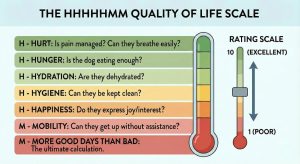
Veterinarian Dr. Alice Villalobos developed a quality of life scale that is widely used in the US. It is called the HHHHHMM Scale. When you are having a bad week with your senior, go through this list and rate each factor from 1 to 10.
- Hurt: Is pain successfully managed? Can they breathe easily?
- Hunger: Is the dog eating enough?
- Hydration: Are they dehydrated?
- Hygiene: Can they be kept clean? Are they sitting in their own mess?
- Happiness: Do they express joy/interest? Do they greet you?
- Mobility: Can they get up without assistance? Can they stumble for a potty break?
- More Good Days Than Bad: The ultimate calculation.
If the score is dropping, it is time to have a frank, compassionate conversation with your vet.
Conclusion: The Privilege of the Gray Muzzle
Caring for a senior dog is not a burden; it is a privilege. These dogs have spent their entire lives studying us, comforting us, and waiting for us to come home. Now, it is our turn to be the ones waiting for them to slowly climb the stairs, comforting them when they are confused, and studying them for signs of need.
The senior years can be some of the deepest, most connected years of your relationship. They don’t need long hikes or fancy toys anymore; they just need comfort, routine, and you.
By following the points in this guide—managing mobility, dialing in nutrition, staying on top of “silent” pain, and keeping their minds sharp—you aren’t just keeping them alive. You are giving them a life worth living.
Welcome to the senior dog club. It’s the best club in the world.
FAQs About Senior Dog Care
1. What age should I start “senior dog care”?
For most dogs, start adjusting care around 8 years old, earlier (6–7) for giant breeds, and a bit later for many small dogs. When in doubt, ask your vet, “Would you consider my dog a senior now?”
2. How often should a senior dog see the vet?
Most senior dogs in the USA should see the vet about every 6 months for a wellness exam, even if they “seem fine.” This allows earlier detection of chronic disease and better pain management.
3. Do all senior dogs need “senior” dog food?
Not always. “Senior” labels vary by brand. What matters most is your dog’s individual needs: weight, muscle condition, existing diseases, and appetite. Your vet can recommend whether a senior formula, a special medical diet, or just adjusting portions is best.
4. How much exercise should an older dog get?
Most seniors do well with short, gentle, regular walks rather than long, intense sessions. You want them to move enough to keep muscles and joints working, but not so much that they’re stiff or exhausted afterward. If your dog limps or struggles after exercise, ask your vet how to adjust their routine.
5. Is it normal for senior dogs to be “grumpy”?
Some change in tolerance is common, especially if your dog has pain, vision loss, or cognitive changes. But sudden aggression or big personality changes are not something to ignore. They’re often a sign of pain, fear, or neurological issues. Talk to your vet; sometimes better pain control or behavior support can make a huge difference.
Disclaimer
While I am a veterinarian, I am not your dog’s veterinarian. The information provided in this article is for educational purposes only and does not constitute medical advice. Every senior dog has a unique health profile. Always consult with your local veterinarian in the US before starting new supplements, exercise routines, or changing your dog’s diet.
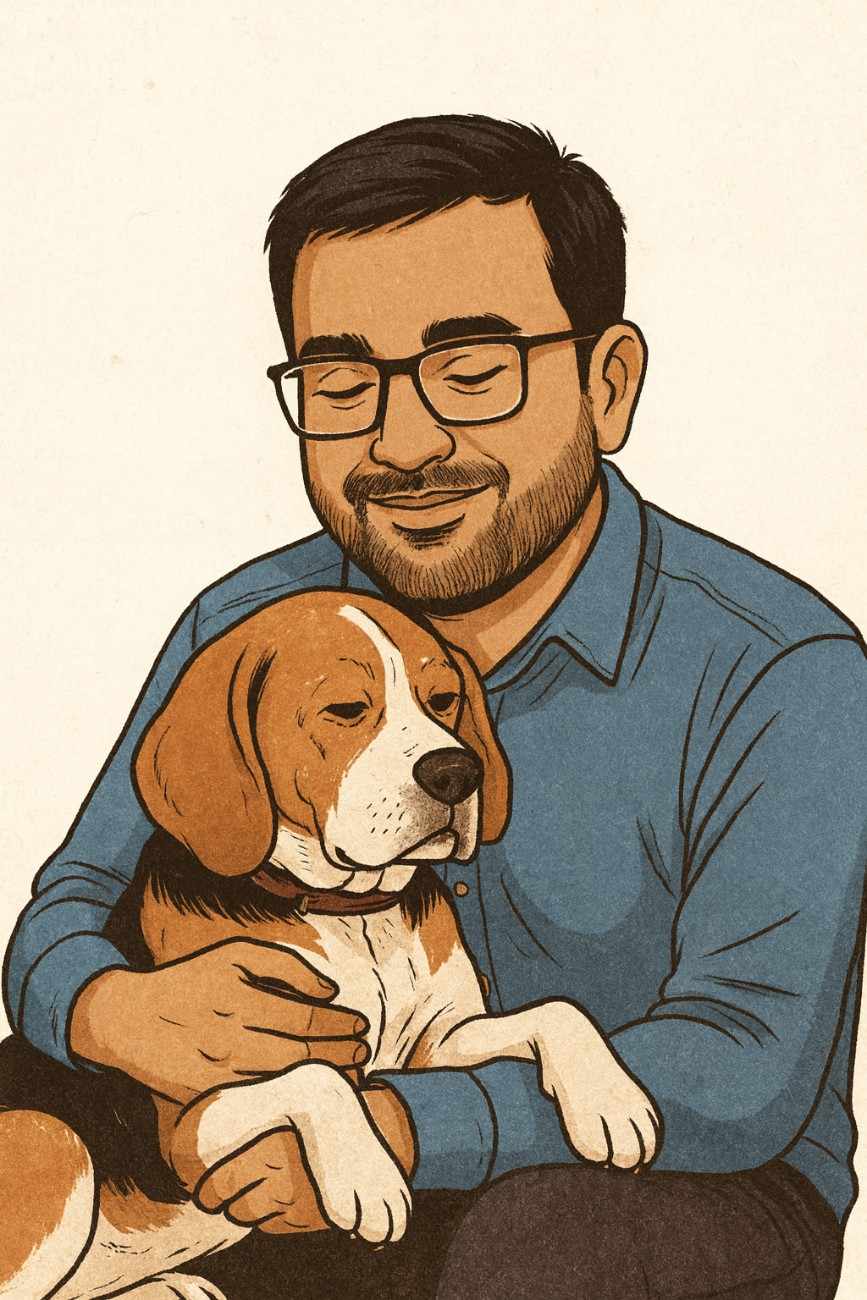
I created this platform with a single mission: to bridge the gap between complex medical information for senior dog owners and practical loving home care.
My Background: I hold a Bachelor of Veterinary Science (BVSc). My education gave me the medical foundation to understand the physiology of aging dogs, from joint mobility to nutritional needs.