
By Dr. Nimish [B.V.Sc] | Veterinarian & Founder of Feedelpoint
There is a myth in the dog world that is incredibly dangerous. It is the belief that if a dog is in pain, they will cry.
We expect yelping. We expect whining. We expect dramatic limping. So when our 9-year-old Labrador stops chasing the ball and starts sleeping more, we simply smile and say, “Well, he’s just becoming a grumpy old man.”
As a veterinarian, I have to tell you the hard truth: He isn’t grumpy. He is hurt and these are early Signs of Arthritis in Senior Dogs
Arthritis (Osteoarthritis) is the number one cause of chronic pain in dogs in the United States. It affects 1 in 5 adult dogs, and a staggering 80% of senior dogs. But here is the kicker: very few of them will ever cry out because of it.
Dogs are stoic. In the wild, a wolf that whines about a sore hip gets left behind by the pack or targeted by a predator. Your domestic dog still has that evolutionary software running in their brain. They will mask their discomfort until the biology literally forces them to show it.
This article is about the “Silent Phase.” These are the subtle, behavioral, and physical whispers of arthritis that appear months—sometimes years—before the limp starts. If you can catch arthritis at this stage, you can change your dog’s entire future.
“If you’re just starting to notice changes in your older dog, you’ll love my full Senior Dog Mobility & Joint Care Guide: From First Limp to Daily Comfort – it walks you through everything from the first limp to daily comfort.”
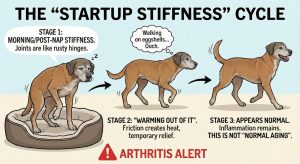
1. The “Startup Stiffness” (The Rusty Hinge Effect) First Signs Of Arthritis In Senior Dogs
This is the classic “Goldilocks” symptom. You usually see it first thing in the morning or after a long nap.
Your dog wakes up. They stand up slowly, maybe stretching their back legs out carefully. They take five or six short, choppy steps. They look like they are walking on eggshells. But then, after a minute of moving around, they seem fine. They trot to the door, wag their tail, and look normal.
Owners often ignore this because it goes away. We call this “warming out of it.”
Think of an arthritic joint like a rusty gate hinge. When you first try to open it, it screams and resists. But if you swing it back and forth a few times, the friction creates heat, the oil loosens up, and it moves smoothly. The rust is still there—it’s just temporarily lubricated.
If your dog is stiff for the first 30 seconds of the day, they have arthritis. This is not “normal aging”; it is inflammation.
2. The Behavior Shift: From “Sweet” to “Grumpy”
Pain changes personality. One of the most heartbreaking things I see in the clinic is a family thinking they have to rehome their senior dog because he “snapped” at the toddler.
In many cases, that dog isn’t aggressive; he is protecting a painful hip.
If your dog has lower back pain (lumbosacral disease) or hip dysplasia, they feel vulnerable. If a child (or another dog) comes running up to them, they know they can’t move fast enough to get away. Their “flight” response is broken, so they switch to “fight.”
Watch for these personality flips:
- The Withdrawal: Your dog used to sleep in the middle of the living room chaos. Now, they seek out quiet corners, under tables, or empty bedrooms. They are isolating themselves to avoid being bumped into.
- The “Look Away”: When you go to pet their head or back, do they lean into it, or do they subtly turn their head away or dip their back? That flinch is a polite way of saying “no thank you.”
- Touch Sensitivity: If your dog suddenly hates being brushed near the tail or hates having their paws wiped, this is a massive red flag for spinal or joint pain.
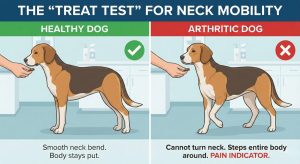
3. The “Treat Test” (Checking Neck Mobility)
Arthritis doesn’t just happen in the legs; it happens in the spine and neck, too. Neck pain is excruciating, but dogs show it in weird ways.
You can test this right now with a piece of high-value food (like cheese or chicken).
How to do it:
- Have your dog stand comfortably.
- Hold the treat at their nose level.
- Slowly move the treat toward their shoulder/rib cage, encouraging them to turn their head to take it without moving their feet.
A healthy dog will bend their neck in a smooth curve to grab the treat. A dog with neck arthritis will refuse to turn their head. Instead, they will physically step their entire body around to face the treat. They move like a bus, not a motorcycle. If they can’t turn their neck, they are in pain.
4. The Change in “Sit” Mechanics
I teach all my clients to watch how their dog sits. It is one of the most mechanically complex things a dog does.
A perfect “sit” requires full flexion of the knees (stifles), hips, and ankles (hocks). It’s a deep squat.
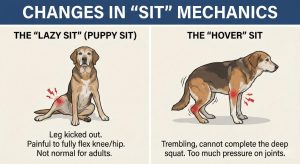
The “Lazy Sit” (Puppy Sit):
You know how puppies sit with their legs sloppy and out to the side? That’s normal for puppies because their joints are loose. It is not normal for a specialized adult dog.
If your senior dog sits with one leg kicked out to the side, or if they roll onto one hip immediately, it’s because fully folding that knee is painful.
The “Hover”:
Some dogs won’t sit at all. You ask them to sit, and they hover their butt three inches off the ground, trembling slightly, before standing back up. They are telling you that the pressure of the deep squat is too much.
5. The “Hesitation” at Obstacles
This is the sign most often blamed on “old age.”
- The Car: Your dog used to launch themselves into the trunk of the SUV. Now, they put their front paws up and look back at you.
- The Stairs: They stand at the bottom of the staircase, looking up. They might pump their head a few times (like a diver preparing to jump) before rushing up the stairs quickly.
- The Bed: They pace back and forth next to your bed, whining or staring at you, waiting to be lifted.
This isn’t laziness. This is a physics calculation. Your dog is calculating the force required to launch their body weight versus the pain it will cause in their rear legs. If they are hesitating, the pain calculation is high.
A Note on Slipping:
Have you noticed your dog avoiding the tiled kitchen floor? Or do they walk through the kitchen very carefully, with their nails clicking loudly?
Arthritic dogs lose muscle tone and stability. Walking on a slick floor feels like walking on ice. If they are avoiding certain rooms in your house, it’s usually because the floor is too slippery for their painful joints.
6. Licking the “Wrist” or “Ankle”
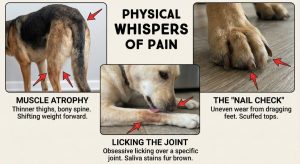
If your dog is obsessively licking one specific spot on their leg, check the joint underneath.
We often mistake this for allergies or a “hot spot” (skin infection). But if the licking is focused precisely over the carpus (wrist) or tarsus (ankle), it is often an attempt to soothe deep internal aches.
The saliva stains the fur a rusty reddish-brown color (due to porphyrins in the saliva). If you see a brown patch on your white dog’s knee, that is a bullseye for pain.
7. Changes in Body Shape (Muscle Atrophy)
Arthritis causes a vicious cycle called disuse atrophy. Because the leg hurts, the dog uses it less. Because they use it less, the muscle shrinks.
Stand behind your dog and look at their back legs. Do their thighs look thinner than they used to? Does their spine look “bony” or prominent?
When the rear legs weaken, the dog shifts all their weight forward. You might notice their chest and shoulders getting huge and muscular (like a bodybuilder) while their back end looks withered. This is them carrying 70% of their weight on their front legs to spare their painful hips.
The “Nail Check” (A Surprise Indicator)
Here is a trick only vets usually know. Look at your dog’s toenails.
In a normal, active dog, the two middle nails wear down evenly because the paw hits the ground flat.
In a dog with arthritis (especially neurological issues or severe weakness), they often drag their feet slightly. This causes the tops of the nails to be scuffed, or the nails to be worn down at weird angles.
Conversely, if the nails are super long, it means the dog isn’t walking enough to wear them down naturally. Long nails change the angle of the foot, which puts more strain on the arthritis. It’s a snowball effect.
When Should You Visit the Vet?
If you read this list and nodded your head at more than two of these signs, it is time to make an appointment.
Do not wait for the annual checkup. Pain is essentially a “wind-up” phenomenon. The longer the nerves are irritated, the better they get at sending pain signals (a process called central sensitization). Treating arthritis early is infinitely easier and cheaper than treating it when the dog can no longer stand up.
What to tell your vet:
Don’t just say “he’s old.” Be specific.
- “He is hesitant to jump in the car.”
- “He is slipping on the kitchen tiles.”
- “He is licking his left wrist.”
We can do a gait analysis, feel the joints for range of motion, and take X-rays to see exactly what is happening.
A Final Note of Hope
Reading this list can feel heavy. It’s hard to admit our best friends are hurting. But identifying the pain is the best gift you can give them. Once we know it’s arthritis, we can do so much. We have new medications (like Librela), therapeutic diets, joint supplements, and simple home changes that can turn back the clock.
A Note on Librela & Safety (What Owners Ask Me) While monoclonal antibodies like Librela (Bedinvetmab) are revolutionizing arthritis care, no medication is without risk. As a veterinarian, I get asked frequently about side effects. The most common side effects reported are mild injection site reactions or increased urination (UTIs).
However, there is an important discussion in the veterinary community regarding dogs with pre-existing neurological conditions. Because Librela targets Nerve Growth Factor (NGF), which plays a role in the nervous system, I am cautious when prescribing it to dogs with degenerative myelopathy or unstable spinal discs. Always give your vet your dog’s full history—including any “wobbly” walking or dragging of feet—before starting this injection. It is a miracle drug for many, but patient selection is key.
I have seen 13-year-old dogs who could barely walk start trotting again once their silent pain was managed. Your dog isn’t “just old.” They are just waiting for you to notice.
FAQs
Q1: Is Librela safe for dogs with Kidney Disease?
Answer: generally, yes. This is one of its biggest advantages. Traditional painkillers like Carprofen (Rimadyl) or Meloxicam are processed by the kidneys and liver, which makes them risky for older dogs with organ failure. Librela is different—it is a “monoclonal antibody” (biological therapy) that is broken down by the body just like a natural protein. It does not put the same heavy load on the kidneys. However, always ensure your vet has up-to-date blood work before starting any new treatment.
Q2: How quickly will I see results after the first injection?
Answer: Patience is key. While some owners see a “miracle” bounce-back within 7 days, it is not the standard. In clinical trials, many dogs needed two doses (60 days) to reach full effectiveness. If you don’t see a massive change after the first shot, do not give up. Give it at least two months to let the medication lower the “wind-up” pain signals in your dog’s nervous system.
Q3: Can I give Librela and NSAIDs (like Galliprant or Carprofen) at the same time?
Answer: officially, the safety of using them together has not been fully established by the manufacturer (Zoetis). However, in “real-world” practice, many veterinarians (myself included) may overlap them for a short transition period—for example, keeping the dog on pills for the first 7 days after the injection to ensure they aren’t in pain while waiting for the shot to kick in. Never mix these on your own; only do so under specific instructions from your vet, as it increases the risk of side effects.
Q4: How much does Librela cost in the US?
Answer: It depends on your dog’s weight. Librela is dosed by body weight, so a Great Dane costs more than a Chihuahua. In 2024/25, most US clinics charge between $80 and $110 per monthly injection for a medium-large dog (roughly 60lbs). Pro-Tip: Some clinics charge a “Tech Appointment” fee (usually $20-$30) just to poke the dog. Ask your vet if you can buy a package of 6 injections upfront to waive those appointment fees.
Q5: My dog seems “wobbly” after the injection. Is this normal?
Answer: This is a rare but reported side effect. Because Librela blocks Nerve Growth Factor (NGF), there have been anecdotal reports of dogs with pre-existing spinal issues (like IVDD or Degenerative Myelopathy) becoming temporarily ataxic (wobbly) or weak in the hind legs. If your dog starts dragging their feet or stumbling after the shot, call your vet immediately. It usually resolves as the drug wears off, but you should not give a second dose without a full neurological exam.
Q6: I am scared of injections. Are there natural alternatives that actually work?
Answer: “Natural” does not always mean “weak,” but you have to be realistic. For mild arthritis, a combination of Omega-3 Fatty Acids (high dose fish oil), Green Lipped Mussel (brand name Antinol or YuMove), and Weight Loss can work wonders. However, for a dog that is already limping or struggling to stand, supplements alone are rarely enough. I often tell clients: “Use medicine to put out the fire, and supplements to keep the house from burning down again.”
Q7: Is my 14-year-old dog “too old” to start treatment?
Answer: Absolutely not. Age is not a disease. I have started patients on arthritis protocols at 15 and seen them enjoy their 16th birthday running on the beach. As long as your dog has a good appetite and enjoys your company, they deserve to be pain-free. Managing their pain is often the single best way to extend their life, because pain causes stress, and stress hurts the immune system.
Veterinary Disclaimer
I am a veterinarian, but I am not your dog’s veterinarian. The information provided in this article is for educational purposes only and does not constitute medical advice. If you suspect your dog is in pain, please schedule a physical exam with your local veterinarian in the US immediately.
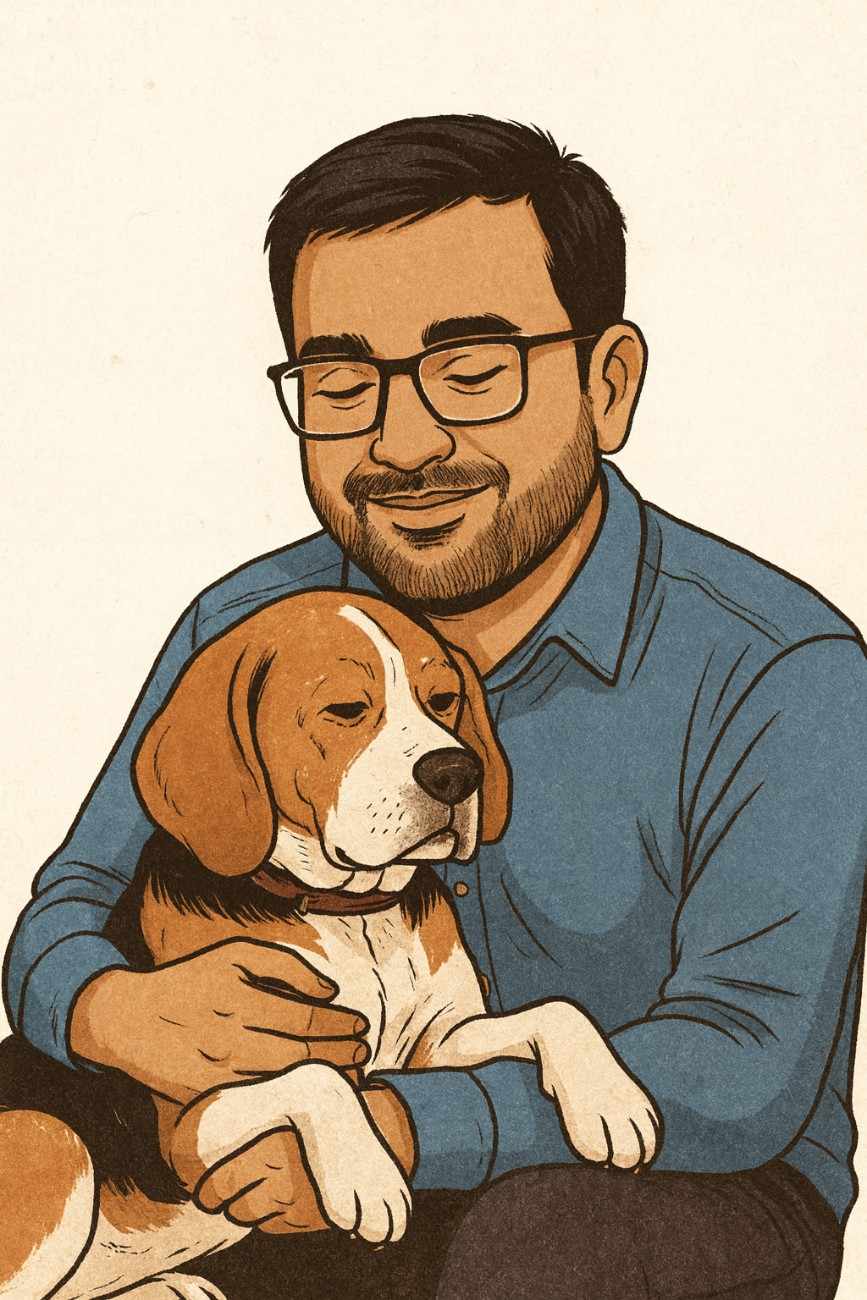
I created this platform with a single mission: to bridge the gap between complex medical information for senior dog owners and practical loving home care.
My Background: I hold a Bachelor of Veterinary Science (BVSc). My education gave me the medical foundation to understand the physiology of aging dogs, from joint mobility to nutritional needs.